


So, I like holidays. I love winter holidays. I think it is more crucial than can probably be expressed for us all to feel some sense of camaraderie and celebration when it gets cold and the sun is gone. As someone who feels the affects of the season (literally, as in Seasonal Affective Disorder), I very, very much appreciate the winter holidays.
I don't really like that the new year starts in January, though.
Obviously I'm just one human and my opinion on these things isn't going to stop people from calling this the new year. But I can't be the only one who thinks that they had a better idea in the days of yore in some random parts of the globe when they celebrated a new year in April instead of January. You know, when the snow has melted and the sun has come back and animals are being born and plants are starting to spring out of the earth and grow new buds and everyone is cheerful to be outside again? Seems a lot more like a renewal to me.
I don't feel very renewed this week. There's nothing about the procession of days through the winter that makes me want to examine my life and make resolutions about things I'd like to change. It feels to me more like something to get through, a season for storing stuff to deal with once the sun comes out and I've got more energy.
This year, I had a really significant birthday. I even wrote about it here. As holidays go, none are more personal than birthdays, and mine this year was an opportunity to do just what I don't feel like right now: take a look at my life and spur some action towards the things I really wanted and needed.
All of which boils down to: I don't have New Year's resolutions. Maybe you'll see some from me in April, but most likely I'll be making them for myself, on a day that makes sense to me and has very little to do with huge snow storms, heavy clothing, and darkness at 5:00pm.
Websites I Love
Showing posts with label culture. Show all posts
Showing posts with label culture. Show all posts
What is Sex?
I just realized (again) that I've never talked about what sex is on this blog.
I write about sex all the fucking time, and yet I've never really defined what it is that I'm writing about. I mean, sure, there's a common definition of what counts as sex. I've encountered it, and I think it's really stupid.
See, most people seem to think that the only thing that's "really" sex is some kind of penetrative (enveloping?) intercourse. Vaginal, anal. With a man's (bio) cock. That's it. Everything else is just "foreplay" or "after play" and what's important is the "play" part that only includes fucking.
But, um, I really think that cock sucking is sex. And pussy licking. And finger fucking. And fisting. And using anal beads. Hand jobs in the back of a movie theater. Fucking someone with my dildo. Fingers on my clit through my panties. A mouth on my nipples and really hot, long makeout sessions, too.
The way I see it, if I could have an orgasm from it, or my partner could have an orgasm from it, it definitely counts as sex. If I'm thinking about it for days afterwards, if I could fantasize about it while I masturbate, that's probably sex, too. The things that matter to me are the feelings, the kind of connection I'm experiencing, not some technicality of what body part entered where.
The problem with only considering Penis-In-Whatever intercourse to be sex is that it excludes a whole range of very pleasurable and definitely sexual activities from what we think "counts." I've written before about how the definition of sex as intercourse excludes the activities that make a majority of women have an orgasm. Like, you know, touching the clitoris at all. There's also the fact that lesbians are pretty much unable to have sex under this model. Which is just silly.
The number of people I've actually fucked is definitely lower than the number of people I've considered sex partners. Especially given the women on my list. But I'd rather honor the experiences I've had, honor the partners I've shared my time and my body with, and be that much more of a slut. Because I'm proud of my history, and all the kinds of sex I've had with all kinds of people!
I write about sex all the fucking time, and yet I've never really defined what it is that I'm writing about. I mean, sure, there's a common definition of what counts as sex. I've encountered it, and I think it's really stupid.
See, most people seem to think that the only thing that's "really" sex is some kind of penetrative (enveloping?) intercourse. Vaginal, anal. With a man's (bio) cock. That's it. Everything else is just "foreplay" or "after play" and what's important is the "play" part that only includes fucking.
But, um, I really think that cock sucking is sex. And pussy licking. And finger fucking. And fisting. And using anal beads. Hand jobs in the back of a movie theater. Fucking someone with my dildo. Fingers on my clit through my panties. A mouth on my nipples and really hot, long makeout sessions, too.
The way I see it, if I could have an orgasm from it, or my partner could have an orgasm from it, it definitely counts as sex. If I'm thinking about it for days afterwards, if I could fantasize about it while I masturbate, that's probably sex, too. The things that matter to me are the feelings, the kind of connection I'm experiencing, not some technicality of what body part entered where.
The problem with only considering Penis-In-Whatever intercourse to be sex is that it excludes a whole range of very pleasurable and definitely sexual activities from what we think "counts." I've written before about how the definition of sex as intercourse excludes the activities that make a majority of women have an orgasm. Like, you know, touching the clitoris at all. There's also the fact that lesbians are pretty much unable to have sex under this model. Which is just silly.
The number of people I've actually fucked is definitely lower than the number of people I've considered sex partners. Especially given the women on my list. But I'd rather honor the experiences I've had, honor the partners I've shared my time and my body with, and be that much more of a slut. Because I'm proud of my history, and all the kinds of sex I've had with all kinds of people!


Victim Blaming and "Just Trying to Help"
I've often struggled when talking to ordinary folks who, after a woman is sexually assaulted or even just in a general discussion of rape and sexual assault, focus to the exclusion of all else on what the victim could do or could have done to prevent an assault. I can clearly articulate that saying these things to a sexual assault survivor after her experience is only going to make her feel guilty for what was clearly a crime against her. Many, if not even close to all, people can get that.
What I've had trouble explaining is why that kind of rhetoric is bad even when we're just talking about rape as a concept or on a societal level. I've had more than one person answer with: "But it's true that there are things one can do to decrease the risk of sexual assault. Why shouldn't I point that out? Couldn't it help someone avoid it?"
Always Aroused Girl has helped me out immensely with this by smoothly articulating what's wrong with looking to the victim for the reason why a rape or assault happened or for the responsibility to prevent them.
What I've had trouble explaining is why that kind of rhetoric is bad even when we're just talking about rape as a concept or on a societal level. I've had more than one person answer with: "But it's true that there are things one can do to decrease the risk of sexual assault. Why shouldn't I point that out? Couldn't it help someone avoid it?"
Always Aroused Girl has helped me out immensely with this by smoothly articulating what's wrong with looking to the victim for the reason why a rape or assault happened or for the responsibility to prevent them.
While it might (might!) be appropriate to educate our sisters and daughters about “sexual assault prevention tips” and “sending messages” before they set foot out the door, once an assault — or “almost” assault — has taken place, it’s time to shut up and listen. Advice about what the survivor might have done differently or should do the next time amounts to nothing more than victim blaming.
Every single time. Sincere or not. “Just trying to help” or not.
People who don’t want themselves or their loved ones to be assaulted feel great comfort in handing out those tips because they give the illusion of control. “You should never have gone to his house!” they say, or “You should have said ‘NO’ more firmly,” but what they really mean is that they hope that those strategies will work for them if they should be so unfortunate as to be assaulted.
They are wearing blinders. While I’d like to feel pity for their sightless state I cannot, because every time they try to rationalize assault, they hurt the ones who have lived through it.
Inadequate Language for Play Partners
I really struggle with what to call the people I'm dating when I'm referring to them in conversation. I really dislike the terms "boyfriend" and "girlfriend" because they imply all kind of things about commitment levels and monogamy. I don't want someone I'm talking to (or dating!) to think that I'm unavailable because I'm referring to someone else as my boyfriend. It just comes with too many expectations and connotations.
Calling someone I'm wildly attracted to and dating and fucking regularly my friend, though, is a little ridiculous. And the linguistic contortions that I've tried so far all have a bit of a silly note. "Partner" sounds like a business acquaintance. "Sweetheart" sounds sappy and old-fashioned. "Fuckbuddy" is too crude and doesn't give enough credit to the friendship/intimacy part. "Special friend" is way too euphemistic. "Lover" is the one I'm most inclined to use, but even that sounds pretentious and a little goofy.
There's also the issue of being in that space where you've started dating someone but don't have commitments yet. . . But you might be moving towards that. . . But you don't want to jump the gun or give people wrong ideas before you're ready to embrace a relationship. Kind of like how people don't announce a pregnancy in the first month because it's likely to miscarry. Silly in a way not to tell anyone, and it doesn't give enough credit to how sad and how common it is to have a miscarriage, but you don't want to have to repeatedly explain what's happened to everyone if it doesn't work out.
One of my coworkers calls her most important partner her "jellybean," which is pretty cute. I suppose that could be the answer: an otherwise meaningless word that you can then explain to mean whatever your relationship status happens to be. I wish there was something easier in our language, but I guess that's what poly pioneers and rapid progress are for! Anyone else have any great ideas?
Calling someone I'm wildly attracted to and dating and fucking regularly my friend, though, is a little ridiculous. And the linguistic contortions that I've tried so far all have a bit of a silly note. "Partner" sounds like a business acquaintance. "Sweetheart" sounds sappy and old-fashioned. "Fuckbuddy" is too crude and doesn't give enough credit to the friendship/intimacy part. "Special friend" is way too euphemistic. "Lover" is the one I'm most inclined to use, but even that sounds pretentious and a little goofy.
There's also the issue of being in that space where you've started dating someone but don't have commitments yet. . . But you might be moving towards that. . . But you don't want to jump the gun or give people wrong ideas before you're ready to embrace a relationship. Kind of like how people don't announce a pregnancy in the first month because it's likely to miscarry. Silly in a way not to tell anyone, and it doesn't give enough credit to how sad and how common it is to have a miscarriage, but you don't want to have to repeatedly explain what's happened to everyone if it doesn't work out.
One of my coworkers calls her most important partner her "jellybean," which is pretty cute. I suppose that could be the answer: an otherwise meaningless word that you can then explain to mean whatever your relationship status happens to be. I wish there was something easier in our language, but I guess that's what poly pioneers and rapid progress are for! Anyone else have any great ideas?
Study on Casual Sex by the Genius Behind Scarleteen
Heather Corinna of Scarleteen.com has recently begun conducting an internet study on casual sex. There's been a lot of media and blog attention paid to "hook up culture" in recent years, and she's trying to get a wide perspective on the phenomenon. I think, largely, to look at whether casual sex is really all that different these days, and how if at all it's changed over the years.
To that end, she's particularly looking for people of diverse ages, sexualities, genders, races, etc. The only qualifications to take the survey are that you are over 16 years of age and have had at least one sexual partner of any kind.
The survey takes about 20 minutes, and I hope some of you will take it. I'll be interested to see what she comes up with.
To that end, she's particularly looking for people of diverse ages, sexualities, genders, races, etc. The only qualifications to take the survey are that you are over 16 years of age and have had at least one sexual partner of any kind.
The survey takes about 20 minutes, and I hope some of you will take it. I'll be interested to see what she comes up with.
The History of Removing Women's Body Hair
In case you couldn't have guessed, the practice of removing female body hair in Western culture and especially North America started with advertising.
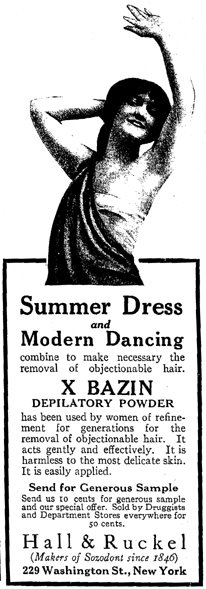
When sleeveless dresses became popular shortly after the invention of the razor with disposable blades (planned obsolescence anyone?), it was an obvious step for advertisers to try to sell the razors to women. What better way than making them think their armpit hair was unsanitary and needed to be removed?
The above image from 1915 was the first in a widespread campaign which increasingly suggested to women that their hair was dirty and distasteful. Now, this particular advertising trend had to do specifically with underarm hair. The disgust for leg hair and need for razors to shave it off was encouraged later, after hemlines began to rise. Women had to be self-conscious about their newly visible body parts in order to convince them to pay to alter them.
It's a little harder to pinpoint exactly when women started shaving their legs. There seems to be a consensus that it happened in the 1940s when skirts got shorter and sheer pantyhose became available. Some speculate that it had something to do with pinup model Betty Grable showing off her hairless legs and inspiring others to do the same.
Complete removal of pubic hair is a different story, actually. This was less driven by the advertising industry than by the porn industry. If you're a pornie, you've probably seen some of those old 1970s pornos where the women still sported the full bush. Pubic hair got shorter and shorter as porn became more and more accessible via VHS, DVD, and then finally the internet. As it became viable for more people to get into porn, it also became useful to remove their hair, the only visual obstacle to intense closeups of pink vulvas.
So, ladies, the fact that you're socially pressured in a huge way to remove all the hair on your body (except the long locks on your head) comes almost exclusively from industry and advertising. It has nothing really to do with hygiene or femininity, it's just about profits and products. I mean, that's no different than other staples of beauty standards like makeup and anti-aging products, etc. It's just equally depressing.
When sleeveless dresses became popular shortly after the invention of the razor with disposable blades (planned obsolescence anyone?), it was an obvious step for advertisers to try to sell the razors to women. What better way than making them think their armpit hair was unsanitary and needed to be removed?
The above image from 1915 was the first in a widespread campaign which increasingly suggested to women that their hair was dirty and distasteful. Now, this particular advertising trend had to do specifically with underarm hair. The disgust for leg hair and need for razors to shave it off was encouraged later, after hemlines began to rise. Women had to be self-conscious about their newly visible body parts in order to convince them to pay to alter them.
It's a little harder to pinpoint exactly when women started shaving their legs. There seems to be a consensus that it happened in the 1940s when skirts got shorter and sheer pantyhose became available. Some speculate that it had something to do with pinup model Betty Grable showing off her hairless legs and inspiring others to do the same.
Complete removal of pubic hair is a different story, actually. This was less driven by the advertising industry than by the porn industry. If you're a pornie, you've probably seen some of those old 1970s pornos where the women still sported the full bush. Pubic hair got shorter and shorter as porn became more and more accessible via VHS, DVD, and then finally the internet. As it became viable for more people to get into porn, it also became useful to remove their hair, the only visual obstacle to intense closeups of pink vulvas.
So, ladies, the fact that you're socially pressured in a huge way to remove all the hair on your body (except the long locks on your head) comes almost exclusively from industry and advertising. It has nothing really to do with hygiene or femininity, it's just about profits and products. I mean, that's no different than other staples of beauty standards like makeup and anti-aging products, etc. It's just equally depressing.
Rapists are Nearly Always Predators
I've had two blog posts by Thomas over at Yes Means Yes up in my Firefox browser for a while, meaning to write about them here. They are both fairly lengthy but very, very worth reading.
In the first, he talks about who the people are who rape repeatedly without getting caught. He discusses a couple of surveys where researchers managed to identify and question un-incarcerated rapists. A few key points from the post:
That's what blew my mind. I've heard the rhetoric about acquaintance rape, that it's committed by guys who did it by accident, who were just confused and fucked up about consent because of our weird sexual culture. I bought into that.
The studies in these posts explain that this is clearly not true, that rapes are committed by predators, plain and simple. This actually made me feel better. Yes, I still will never know upon meeting a man whether or not he's a rapist, but at least the ones that are rapists aren't accident-prone nice guys who I should feel bad for. I need no conflict in my feelings. They're evil. And we can identify them, if we watch for the signs he points out.
That's pretty damn cool.
In the first, he talks about who the people are who rape repeatedly without getting caught. He discusses a couple of surveys where researchers managed to identify and question un-incarcerated rapists. A few key points from the post:
Of the 865 total attempted or completed rapes these men admitted to, a staggering 95% were committed by 96 men, or just 8.4% of the sample...Just 4% of the men surveyed committed over 400 attempted or completed rapes...The second post is sort of an expansion on the first. In it, Thomas explains how it is that serial rapists manage to commit their crimes without detection. Namely, by raping people they know and by using intoxicants much more than force to make the rape possible.
The sometimes-floated notion that acquaintance rape is simply a mistake about consent, is wrong. The vast majority of the offenses are being committed by a relatively small group of men, somewhere between 4% and 8% of the population, who do it again … and again … and again...
We need to spot the rapists, and we need to shut down the social structures that give them a license to operate. They are in the population, among us. They have an average of six victims, women that they know, and therefore likely some women you know. They use force sometimes, but mostly they use intoxicants. They don’t accidentally end up in a room with a woman too drunk or high to consent or resist; they plan on getting there and that’s where they end up.
In the course of 20 years of interviewing these undetected rapists, in both research and forensic settings, it has been possible for [the researcher] to distill some of the common characteristics of the modus operandi of these sex offenders. These undetected rapists:Now, I am not able to do these posts justice with brief blockquotes. I really do suggest that everyone go and read the full posts, as long as they are. They're both very informative and I finished reading them with the sense that, yes, dear God, rape is awful and these are horrible men, but also with the sense that maybe there's something we can actually do about it that would work.
• are extremely adept at identifying “likely” victims, and testing prospective victims’ boundaries;
• plan and premeditate their attacks, using sophisticated strategies to groom their victims for attack, and to isolate them physically;
• use “instrumental” not gratuitous violence; they exhibit strong impulse
control and use only as much violence as is needed to terrify and coerce their victims into submission;
• use psychological weapons – power, control, manipulation, and threats – backed up by physical force, and almost never resort to weapons such as knives or guns;
• use alcohol deliberately to render victims more vulnerable to attack, or completely unconscious.
That's what blew my mind. I've heard the rhetoric about acquaintance rape, that it's committed by guys who did it by accident, who were just confused and fucked up about consent because of our weird sexual culture. I bought into that.
The studies in these posts explain that this is clearly not true, that rapes are committed by predators, plain and simple. This actually made me feel better. Yes, I still will never know upon meeting a man whether or not he's a rapist, but at least the ones that are rapists aren't accident-prone nice guys who I should feel bad for. I need no conflict in my feelings. They're evil. And we can identify them, if we watch for the signs he points out.
That's pretty damn cool.
What/Who I Want
So, the result of my last two posts has some pretty specific implications for what/who I am looking for in a partner.
Male. Feminist. Dominant. Polyamorous. Queer.
Do I even need to say that these people are hard to find? Especially the ones who I'm, incidentally, also attracted to? Yeesh.
A friend of mine suggested I find poly events to go to, as poly people are often also kinky. Sometimes they're queer, too, although lord knows how I'm going to find or negotiate that overlap.
Maybe now that I've figured out so much more clearly what I want, I'll feel more comfortable in the sex positive community. It always felt a little overwhelming and I never felt like I had enough of a handle on my own sexuality to communicate about it freely with the well-informed participants in that culture.
I always felt very young, inexperienced, and out of place there. Yes, it was very welcoming and they're kind people, but I'm a person who likes to have a handle on things before I jump in to participate, so I still felt like an outsider. Perhaps all this soul searching will mitigate that issue.
Does anyone else have this problem, of too narrow a field of prospective datees? What do you do to meet people? Any suggestions for me to find my kinky, queer, male, poly feminist? I'd very much welcome them.
P.S. I'm not letting go of the whole "bisexual" thing entirely. I still like women and having sex with them. I think there are just more men out there to whom I'll be attracted than there are women. Like, I'm a Kinsey 1.6: predominantly hetero but a bit more than incidentally homo. So I'm going to acknowledge that and just let it be.
Male. Feminist. Dominant. Polyamorous. Queer.
Do I even need to say that these people are hard to find? Especially the ones who I'm, incidentally, also attracted to? Yeesh.
A friend of mine suggested I find poly events to go to, as poly people are often also kinky. Sometimes they're queer, too, although lord knows how I'm going to find or negotiate that overlap.
Maybe now that I've figured out so much more clearly what I want, I'll feel more comfortable in the sex positive community. It always felt a little overwhelming and I never felt like I had enough of a handle on my own sexuality to communicate about it freely with the well-informed participants in that culture.
I always felt very young, inexperienced, and out of place there. Yes, it was very welcoming and they're kind people, but I'm a person who likes to have a handle on things before I jump in to participate, so I still felt like an outsider. Perhaps all this soul searching will mitigate that issue.
Does anyone else have this problem, of too narrow a field of prospective datees? What do you do to meet people? Any suggestions for me to find my kinky, queer, male, poly feminist? I'd very much welcome them.
P.S. I'm not letting go of the whole "bisexual" thing entirely. I still like women and having sex with them. I think there are just more men out there to whom I'll be attracted than there are women. Like, I'm a Kinsey 1.6: predominantly hetero but a bit more than incidentally homo. So I'm going to acknowledge that and just let it be.
On Satire
http://www.feministe.us/blog/archives/2009/12/04/rape-the-method-by-josh-brorby/
This post on Feministe (I think I'm a bit late responding to this one, but my thoughts stand nonetheless) made me think hard and very clearly about the difficulty of satire being such a thoroughly appreciated and oft-attempted medium in this day and age.
Since I stopped writing my college sex column, a variety of other collegiate types have taken it over. They almost uniformly attempt to write "satire" that is as poorly written as Mr. Brorby's and frequently deals with the same topics. It's sexist, sex negative, and supposedly "all a joke." It just tends to be so very, very poorly done that it comes off as a bashing of sexuality as a whole, and most often specifically of women.
This is immensely frustrating. It's actually the reason I applied to start writing the article, and I made a very serious effort to be funny in my writing but also respectful and inclusive. I think I did a fairly good job, but I have no control over what happens now. It's just back to the way it was before.
I see this a lot with amateurish writing, be it blogs or college newspapers or even real-world but poorly-written-and-edited publications. People think they are quite clever, but they manage to just make a muck of out what they're trying to say and perpetuate the awful cultural trends that they're trying to critique. I think any newspaper writer should have to go through a mandatory "Art of Satire" class before they're allowed to have any creative control over what they publish. Or just, whatever, the world should stop being so sexist and sex-negative and rasist and classist and miserable. Yeah.
This post on Feministe (I think I'm a bit late responding to this one, but my thoughts stand nonetheless) made me think hard and very clearly about the difficulty of satire being such a thoroughly appreciated and oft-attempted medium in this day and age.
Since I stopped writing my college sex column, a variety of other collegiate types have taken it over. They almost uniformly attempt to write "satire" that is as poorly written as Mr. Brorby's and frequently deals with the same topics. It's sexist, sex negative, and supposedly "all a joke." It just tends to be so very, very poorly done that it comes off as a bashing of sexuality as a whole, and most often specifically of women.
This is immensely frustrating. It's actually the reason I applied to start writing the article, and I made a very serious effort to be funny in my writing but also respectful and inclusive. I think I did a fairly good job, but I have no control over what happens now. It's just back to the way it was before.
I see this a lot with amateurish writing, be it blogs or college newspapers or even real-world but poorly-written-and-edited publications. People think they are quite clever, but they manage to just make a muck of out what they're trying to say and perpetuate the awful cultural trends that they're trying to critique. I think any newspaper writer should have to go through a mandatory "Art of Satire" class before they're allowed to have any creative control over what they publish. Or just, whatever, the world should stop being so sexist and sex-negative and rasist and classist and miserable. Yeah.
Schroedinger's Rapist
I want to share with you all a guest post at Shapely Prose by writer Phaedra Starling that I found not long ago which has put a lot of my thoughts about public interactions with men into words. It's not a short post, but I really recommend reading the whole thing, especially if you happen to possess a penis.
The post discusses how, when one approaches a woman in public, it's really important to be aware that she does not know whether or not you're a rapist. An excerpt:
The post discusses how, when one approaches a woman in public, it's really important to be aware that she does not know whether or not you're a rapist. An excerpt:
Consider: if every rapist commits an average of ten rapes (a horrifying number, isn’t it?) then the concentration of rapists in the population is still a little over one in sixty. That means four in my graduating class in high school. One among my coworkers. One in the subway car at rush hour. Eleven who work out at my gym. How do I know that you, the nice guy who wants nothing more than companionship and True Love, are not this rapist?Now, there have been some negative reactions to her tone. I think, given the subject matter, that it's called-for, although perhaps her condescension is unhelpful. If you can disregard the talking down just for a minute, though, and if you hear all the dismal statistics and despair at the state of affairs, if you wonder how you can successfully approach a woman without being a creeper, or if you're just really awesome, read the rest of the article. It's worth it.
I don’t.
When you approach me in public, you are Schrödinger’s Rapist. You may or may not be a man who would commit rape. I won’t know for sure unless you start sexually assaulting me. I can’t see inside your head, and I don’t know your intentions. If you expect me to trust you—to accept you at face value as a nice sort of guy—you are not only failing to respect my reasonable caution, you are being cavalier about my personal safety.
Fortunately, you’re a good guy. We’ve already established that. Now that you’re aware that there’s a problem, you are going to go out of your way to fix it, and to make the women with whom you interact feel as safe as possible.
Gay Bar
I went, tonight, to a gay club in the Castro. San Francisco's pretty fun in that its queer culture is exactly what you'd expect it to be. This club was all techno, mostly gay people, more men than women, and a good amount of drinking. It was packed. The bodies writhed together. It might as well have been a scene from Queer as Folk. (Although I know that was set in another city.)
I went to gay bars and clubs a lot throughout my college career. There was a period of time where I'd go to a gay bar at least three nights a week, to socialize and sometimes dance and sometimes drink.
I didn't like going to straight dance clubs because men would inevitably feel me up or at least hit on me in a very sketchy fashion. At gay bars, there isn't this problem. The men are only interested in each other and the women know better than to be totally disrespectful.
Since I've graduated, though, I've spent less time with queer folks. My job is to canvass for a queer issue, but there are still more straight people at work than gay ones. I'd sort of forgotten how much more comfortable I am within the queer community than I am in the straight one.
I have my own gripes with the gay community, mostly involving their sometimes exclusion of bisexual people. I still feel better, though, with teh gays than with teh straights. There's so much more gender flexibility, such an understanding that gender roles don't have to define everything. It cuts down a lot on the blatant sexism.
I'd forgotten, before tonight, how much more comfortable I feel around gay people than around straight ones. I'm considering taking a little break from dating men, just because I've gotten into such an unfortunate head space about them. Even if I don't skip out on all the less-sexist men who I do like, I'd like to spend more time with gay people. I think it's time to start pursuing women again.
I went to gay bars and clubs a lot throughout my college career. There was a period of time where I'd go to a gay bar at least three nights a week, to socialize and sometimes dance and sometimes drink.
I didn't like going to straight dance clubs because men would inevitably feel me up or at least hit on me in a very sketchy fashion. At gay bars, there isn't this problem. The men are only interested in each other and the women know better than to be totally disrespectful.
Since I've graduated, though, I've spent less time with queer folks. My job is to canvass for a queer issue, but there are still more straight people at work than gay ones. I'd sort of forgotten how much more comfortable I am within the queer community than I am in the straight one.
I have my own gripes with the gay community, mostly involving their sometimes exclusion of bisexual people. I still feel better, though, with teh gays than with teh straights. There's so much more gender flexibility, such an understanding that gender roles don't have to define everything. It cuts down a lot on the blatant sexism.
I'd forgotten, before tonight, how much more comfortable I feel around gay people than around straight ones. I'm considering taking a little break from dating men, just because I've gotten into such an unfortunate head space about them. Even if I don't skip out on all the less-sexist men who I do like, I'd like to spend more time with gay people. I think it's time to start pursuing women again.
Self Discipline in Writing, and My Evening
I think it is now time to start forcing myself to post every day. I have been very, very terrible about blogging for the last several months, to state the obvious. This isn't because I've had nothing to talk about; my brain continues to churn regardless of what weird emotional/stress state I'm in. I've had plenty of things percolating.
I just haven't really been writing. Not here, and not for school anymore, and not in my journal, and not anything fictional. Nothing. This, for me, is not a good thing.
Writing keeps me a little more sane, forces me to analyze my life, helps me to understand my feelings and experiences by articulating them. I really need to be doing it more, because I've been letting some good ol' life patterns (like the whole man issue I wrote about in my last post) build up without really dealing with them.
I spent tonight at a bar and then a dance club with a group of people from work, and although I enjoy the company of many of my coworkers, I was left feeling uncomfortable and almost grossed out after this evening. It really had nothing to do with my companions and everything to do with my feelings about men and being surrounded by them.
I was being lightly hit on by one male coworker, Y, who shared that he hasn't had sex in months and is desperate (his word!). He was also pursuing, and talking about pursuing, another coworker who is new to the office. C, the third woman in the group, picked up an Italian guy early on and got him to buy her drinks and make out with her.
I was being more subtly but also more persistently hit on by N, another male coworker who has a girlfriend but who admits that he make-out cheats on her when he's drunk. He kept saying he wanted to drink more so that he could make poor life choices and touching my knees. A random guy outside the club who I talked to for about a minute took the time to make sure that N would be escorting me home as it's not safe out there for a beautiful lady like myself.
I can't really say what it was that bugged me so much about the whole night, I just felt vaguely dirty, as though I was a part of something I didn't like. I wish there was some way to just check out of traditional gender roles entirely, to not be confronted with them all the time. I wish men didn't objectify me constantly based on my confidence and openness around sexuality. I don't want to be someone's wet dream.
I like it when people are attracted to me, sure, but not so much when it's because they think I'll be the perfect lay. Or the perfect anything, for that matter. It's so much nicer when they perceive me as a human, flaws and all.
It's been an off night, and I'll do a better sort later through what was up. I'd like to find some kind of conclusion, a reaction to this discomfort with men, that will help me function better in their presence. It is, after all, a little hard to avoid them altogether.
I just haven't really been writing. Not here, and not for school anymore, and not in my journal, and not anything fictional. Nothing. This, for me, is not a good thing.
Writing keeps me a little more sane, forces me to analyze my life, helps me to understand my feelings and experiences by articulating them. I really need to be doing it more, because I've been letting some good ol' life patterns (like the whole man issue I wrote about in my last post) build up without really dealing with them.
I spent tonight at a bar and then a dance club with a group of people from work, and although I enjoy the company of many of my coworkers, I was left feeling uncomfortable and almost grossed out after this evening. It really had nothing to do with my companions and everything to do with my feelings about men and being surrounded by them.
I was being lightly hit on by one male coworker, Y, who shared that he hasn't had sex in months and is desperate (his word!). He was also pursuing, and talking about pursuing, another coworker who is new to the office. C, the third woman in the group, picked up an Italian guy early on and got him to buy her drinks and make out with her.
I was being more subtly but also more persistently hit on by N, another male coworker who has a girlfriend but who admits that he make-out cheats on her when he's drunk. He kept saying he wanted to drink more so that he could make poor life choices and touching my knees. A random guy outside the club who I talked to for about a minute took the time to make sure that N would be escorting me home as it's not safe out there for a beautiful lady like myself.
I can't really say what it was that bugged me so much about the whole night, I just felt vaguely dirty, as though I was a part of something I didn't like. I wish there was some way to just check out of traditional gender roles entirely, to not be confronted with them all the time. I wish men didn't objectify me constantly based on my confidence and openness around sexuality. I don't want to be someone's wet dream.
I like it when people are attracted to me, sure, but not so much when it's because they think I'll be the perfect lay. Or the perfect anything, for that matter. It's so much nicer when they perceive me as a human, flaws and all.
It's been an off night, and I'll do a better sort later through what was up. I'd like to find some kind of conclusion, a reaction to this discomfort with men, that will help me function better in their presence. It is, after all, a little hard to avoid them altogether.
Canvassing vs. Stripping
To those of you who also work in the sex industry (and some savvy folks who don't), it may not come as a surprise that working as a canvasser is similar in many ways to working as a stripper. That might sound like a stretch, but aside from having to wear a slightly different uniform, a lot of the things I'm doing in my new job as a canvasser to overturn Prop 8 are similar to what I did as a stripper.
I spend all day being cheerful, nice, and attempting to get people to give me money. I have to walk up to strangers, charm them, and get them to like me. I need to be completely comfortable with rejection because more people will walk by me on the street or refuse to open their screen doors than will donate $70 a month. I need to convince people to part with their money in ways they weren't expecting.
One of my immediate supervisors (not the hiring boss) just remarked to me that she's noticed our company doesn't hire unattractive people. The office is pretty diverse in terms of race and sexuality, but nearly everyone is aged 18-27 and is at the very least pretty or cute. This is partly because of who they hire and partly because you have to make a certain amount to stay on staff. Prettier people make more money.
That prettiness principle demonstrates the job's similarity to stripping. It's slightly exploitative, it commodifies people's looks, and it lends itself to a particular staff demographic.
My point here is that stripping is a lot like any other service or public relations job. Yes, it commodifies and sometimes exploits people, but so does canvassing or waiting tables or selling just about anything. It's all labor, stripping just involves less clothing.
That is all.
I spend all day being cheerful, nice, and attempting to get people to give me money. I have to walk up to strangers, charm them, and get them to like me. I need to be completely comfortable with rejection because more people will walk by me on the street or refuse to open their screen doors than will donate $70 a month. I need to convince people to part with their money in ways they weren't expecting.
One of my immediate supervisors (not the hiring boss) just remarked to me that she's noticed our company doesn't hire unattractive people. The office is pretty diverse in terms of race and sexuality, but nearly everyone is aged 18-27 and is at the very least pretty or cute. This is partly because of who they hire and partly because you have to make a certain amount to stay on staff. Prettier people make more money.
That prettiness principle demonstrates the job's similarity to stripping. It's slightly exploitative, it commodifies people's looks, and it lends itself to a particular staff demographic.
My point here is that stripping is a lot like any other service or public relations job. Yes, it commodifies and sometimes exploits people, but so does canvassing or waiting tables or selling just about anything. It's all labor, stripping just involves less clothing.
That is all.
Bisexuality and Dating Men
For the last couple of years, I've dated only men. I've slept with plenty of women, but all the people I've seen consistently or seriously were men. I wouldn't say that I've done this on purpose, but it's been a pretty obvious trend.
I think a lot of the reason for this is simple convenience. There are a lot more straight men scattered around in obvious places than there are queer women. They tend to approach me more often and I end up with them just as a matter of odds. In the past six months or so, I have been on more of a hetero kick, but that's not unusual. I've always gone through cycles of leaning one way or the other every once in a while. I had a lady cycle three years ago, and now I'm going the other way. Woo, fluid sexuality.
This trend of male-dating, however, puts me in a strange and slightly uncomfortable position. I'm a bisexual person who has been very involved in the queer community. In college, most of my female friends were queer. I was part of the leadership of the Gay Straight Alliance. I went to gay bars. Most of my jobs were in specifically queer-friendly or queer-oriented places. I tied a lot of my identity in with queerness.
And yet, most of my relationships were heterosexual. Straight, if you will.
Of course, the fact that my relationships are always open does allow me to sleep with women. That doesn't change the fact, though, that people assume I'm straight when I go out in public with a male sweetheart. It's sort of like the queer part of me is hidden inside myself.
I don't like feeling hidden. I end up questioning myself a lot because there is pressure from both sides to define and present myself as either queer or straight. It's not always an open or spoken pressure, although I've heard my share of "choose already" jokes and not-so-jokes. It's more often a pressure based on the fact that the queer community is so close and clearly-defined. There's a norm there, and there are great rewards of community and support for following it.
I do have a strong desire to be recognized for who I am and to fit in with a group. I'd like to be more independent, but part of my identity is based on how others see me. I suppose that's my own cross to bear, but it makes the bisexuality particularly hard when it keeps me separate from what seems to be such a fun and close-knit group. I'd like to be a part of it.
I'm not letting identity issues stop me from dating whomever I like (or love) or dressing how I want or making friends with whomever I want. It does cause me some angst, though, when I feel excluded not only from the straight world which kind of turns me off anyway, but the queer community that appeals to me.
I think a lot of the reason for this is simple convenience. There are a lot more straight men scattered around in obvious places than there are queer women. They tend to approach me more often and I end up with them just as a matter of odds. In the past six months or so, I have been on more of a hetero kick, but that's not unusual. I've always gone through cycles of leaning one way or the other every once in a while. I had a lady cycle three years ago, and now I'm going the other way. Woo, fluid sexuality.
This trend of male-dating, however, puts me in a strange and slightly uncomfortable position. I'm a bisexual person who has been very involved in the queer community. In college, most of my female friends were queer. I was part of the leadership of the Gay Straight Alliance. I went to gay bars. Most of my jobs were in specifically queer-friendly or queer-oriented places. I tied a lot of my identity in with queerness.
And yet, most of my relationships were heterosexual. Straight, if you will.
Of course, the fact that my relationships are always open does allow me to sleep with women. That doesn't change the fact, though, that people assume I'm straight when I go out in public with a male sweetheart. It's sort of like the queer part of me is hidden inside myself.
I don't like feeling hidden. I end up questioning myself a lot because there is pressure from both sides to define and present myself as either queer or straight. It's not always an open or spoken pressure, although I've heard my share of "choose already" jokes and not-so-jokes. It's more often a pressure based on the fact that the queer community is so close and clearly-defined. There's a norm there, and there are great rewards of community and support for following it.
I do have a strong desire to be recognized for who I am and to fit in with a group. I'd like to be more independent, but part of my identity is based on how others see me. I suppose that's my own cross to bear, but it makes the bisexuality particularly hard when it keeps me separate from what seems to be such a fun and close-knit group. I'd like to be a part of it.
I'm not letting identity issues stop me from dating whomever I like (or love) or dressing how I want or making friends with whomever I want. It does cause me some angst, though, when I feel excluded not only from the straight world which kind of turns me off anyway, but the queer community that appeals to me.
Money
A disorganized and possibly rambling continuation of my thoughts on my privileged stupidity when it comes to money: how did I get this way?
I try to be fairly open about the fact that I come from a very privileged family. For starters: I'm white, started out as Catholic, and my family has a lot of money. My dad is an executive for start-up biotech companies, which means he does very well financially. My mother works very part time and doesn't make much; she could afford to make that choice. Both of my parents are college educated. They both came from upper-middle-class white families. My background is a continuation of theirs.
We did not talk about money in my family when I was growing up. Apparently, it's partly because my father really hates to. I think it's a combination of his being proud of how much he makes and wanting to spend it on his wife and children (quite the patriarchal sentiment, that) and feeling awkward about being richer than most people and living in luxury. Not ridiculous luxury, but luxury nonetheless. There's a nice big dose of white, wealthy guilt in my family and the way it manifests itself is that we DO NOT talk about money.
My dad hands his credit card to waiters at restaurants before they bring him the check, and he just signs it. My mother doesn't check the price tags of things we buy at the grocery store or jeans at the mall. I don't know how much money my dad makes in a year, or in a month, or in a week, or in an hour. I don't know how much our mortgage costs. I don't know how much our food costs. Off the top of my head, I don't even know how much this computer cost.
Maybe sharing all of this is just rubbing the privilege in people's faces, and I shouldn't. I guess my point, though, is that things really shouldn't be this way. One of the things about privilege is that it allows you not to be aware of things like money or race or gender or sexuality.
If you're white, that's supposedly the default race and most white people don't even have to think about their race until they're confronted with a minority person who's bringing it up. I think white people who give in to this option of ignorance are socially irresponsible. I think financially privileged people who give in to the option of ignorance about money are socially irresponsible.
I hate that my parents didn't talk about money just because we didn't have to talk about it. Just because we didn't need to discuss what we couldn't afford or what we needed to miss out on due to lack of funds doesn't mean we shouldn't have been talking about what we could afford and how special that was. It's something I needed to be aware of.
Yes, I heard from time to time that we were lucky people and that we shouldn't take it for granted, but the taking for granted was happening on a daily basis and that's a much stronger message.
I probably won't ever be truly poor. I won't know what that's like. I don't want to let that stop me from feeling empathy for people who are poor or from appreciating what I have. I don't want to let it spoil me, which it seems in part to have done. I don't want it to keep me from being a good, responsible person. I don't want it to stop me from helping people.
So I've got to figure this shit out.
I try to be fairly open about the fact that I come from a very privileged family. For starters: I'm white, started out as Catholic, and my family has a lot of money. My dad is an executive for start-up biotech companies, which means he does very well financially. My mother works very part time and doesn't make much; she could afford to make that choice. Both of my parents are college educated. They both came from upper-middle-class white families. My background is a continuation of theirs.
We did not talk about money in my family when I was growing up. Apparently, it's partly because my father really hates to. I think it's a combination of his being proud of how much he makes and wanting to spend it on his wife and children (quite the patriarchal sentiment, that) and feeling awkward about being richer than most people and living in luxury. Not ridiculous luxury, but luxury nonetheless. There's a nice big dose of white, wealthy guilt in my family and the way it manifests itself is that we DO NOT talk about money.
My dad hands his credit card to waiters at restaurants before they bring him the check, and he just signs it. My mother doesn't check the price tags of things we buy at the grocery store or jeans at the mall. I don't know how much money my dad makes in a year, or in a month, or in a week, or in an hour. I don't know how much our mortgage costs. I don't know how much our food costs. Off the top of my head, I don't even know how much this computer cost.
Maybe sharing all of this is just rubbing the privilege in people's faces, and I shouldn't. I guess my point, though, is that things really shouldn't be this way. One of the things about privilege is that it allows you not to be aware of things like money or race or gender or sexuality.
If you're white, that's supposedly the default race and most white people don't even have to think about their race until they're confronted with a minority person who's bringing it up. I think white people who give in to this option of ignorance are socially irresponsible. I think financially privileged people who give in to the option of ignorance about money are socially irresponsible.
I hate that my parents didn't talk about money just because we didn't have to talk about it. Just because we didn't need to discuss what we couldn't afford or what we needed to miss out on due to lack of funds doesn't mean we shouldn't have been talking about what we could afford and how special that was. It's something I needed to be aware of.
Yes, I heard from time to time that we were lucky people and that we shouldn't take it for granted, but the taking for granted was happening on a daily basis and that's a much stronger message.
I probably won't ever be truly poor. I won't know what that's like. I don't want to let that stop me from feeling empathy for people who are poor or from appreciating what I have. I don't want to let it spoil me, which it seems in part to have done. I don't want it to keep me from being a good, responsible person. I don't want it to stop me from helping people.
So I've got to figure this shit out.
Tea Bagging
Visit msnbc.com for Breaking News, World News, and News about the Economy
I don't think I even need to comment on this. Holy fuck nuts. Laughing my ASS off.
Rallies
As an activist and progressive type and queer and everything else, I keep a deep dark secret. It stays inside of me and only my very closest friends know the truth. I put on a good face and pretend it's not true, but inside I feel the conflict to my core. The reality is this:
I hate rallies.
I know. As someone who wants to toss the Man around a little, who wants change and all sorts of other good things, I'm supposed to be all about large groups standing in the freezing cold and inspirational speeches and chanting and signs. I should love picket lines and dramatic displays and chaining myself to things. I should feel the energy, the burn, the drive, the power of the people!
I don't.
I really think that rallies are most often purely for the benefit of the people holding them. I rarely see any kind of change as a result of a rally. If anything, a successful rally is more often a sign that a change is about to happen. The success of a rally, its high attendance and large effect on public opinion, doesn't make the change, it just shows that it's imminent. A rally won't have high attendance or an effect on public opinion unless people are already leaning towards supporting its cause.
I do know that rallies are an important tool in a campaign. They can show that an idea has the support of lots and lots of people. There is power in numbers. I just get annoyed because too many times rallies are held in substitute for other kinds of activism. It's like "there's a war in Iraq that we disagree with, let's march on city hall and say we don't want unnecessary deaths," but that doesn't actually change the fact that we're at war.
If you've got a big goal, you've got to come at it from lots of directions and protesting isn't enough. We're still in Iraq after years and years of protests; it took a concerted effort from politicians working in countless ways to even get someone in power who wants to consider getting us out. You know, there were legislative actions, and lobbying actions, and opinion polls and public service announcements and whatever else. The rallies were relatively insignificant.
I do go to rallies when they're about a cause I support, but I always feel vaguely annoyed and fatalistically amused at the enthusiasm I see there. Yes, I do sometimes get caught up in the spirit, but mostly I'm just standing at the sides trying not to laugh and cry at the same time.
So this is it, me coming out of the closet as a rally skeptic. Shame, shame, and all of that, but eh, I'll be active in other ways, thank you.
I hate rallies.
I know. As someone who wants to toss the Man around a little, who wants change and all sorts of other good things, I'm supposed to be all about large groups standing in the freezing cold and inspirational speeches and chanting and signs. I should love picket lines and dramatic displays and chaining myself to things. I should feel the energy, the burn, the drive, the power of the people!
I don't.
I really think that rallies are most often purely for the benefit of the people holding them. I rarely see any kind of change as a result of a rally. If anything, a successful rally is more often a sign that a change is about to happen. The success of a rally, its high attendance and large effect on public opinion, doesn't make the change, it just shows that it's imminent. A rally won't have high attendance or an effect on public opinion unless people are already leaning towards supporting its cause.
I do know that rallies are an important tool in a campaign. They can show that an idea has the support of lots and lots of people. There is power in numbers. I just get annoyed because too many times rallies are held in substitute for other kinds of activism. It's like "there's a war in Iraq that we disagree with, let's march on city hall and say we don't want unnecessary deaths," but that doesn't actually change the fact that we're at war.
If you've got a big goal, you've got to come at it from lots of directions and protesting isn't enough. We're still in Iraq after years and years of protests; it took a concerted effort from politicians working in countless ways to even get someone in power who wants to consider getting us out. You know, there were legislative actions, and lobbying actions, and opinion polls and public service announcements and whatever else. The rallies were relatively insignificant.
I do go to rallies when they're about a cause I support, but I always feel vaguely annoyed and fatalistically amused at the enthusiasm I see there. Yes, I do sometimes get caught up in the spirit, but mostly I'm just standing at the sides trying not to laugh and cry at the same time.
So this is it, me coming out of the closet as a rally skeptic. Shame, shame, and all of that, but eh, I'll be active in other ways, thank you.
Domination vs. Humiliation
I was thinking yesterday about my kinky proclivities, and the reasons why until fairly recently I've hesitated to act on my submissive desires. I've known that I'm into restraint and submission for a very long time, but I never did much about it. I didn't feel ready, somehow, or comfortable with the idea.
I realized yesterday that a lot of what turned me off of the available images of dominance and submission was the way humiliation is often connected to any kind of sexy power play. Very often along with the spankings and bindings and hittings and tossing arounds, there are words and narratives thrown in about how humiliating it all is. About how the sub is naughty and should be ashamed and needs to be punished.
For me, the desire to be dominated is not at all connected to these narratives of shame. I don't feel ashamed of having sexual desires. It's true that I have been shamed by other people for them and sometimes even felt abnormal and freakish. My response to that, however, was more to say "fuck you" and learn to be proud than anything else.
I grew up in a household where, despite some of the usual discomfort about sex, my parents and especially mother always said "whatever you do is fine by us and we love all of you, including your sexuality." This stood up to my coming out as bisexual, my disclosing that I'm a stripper, and some overnight visits from special friends where we made a wee bit more noise than intended.
This is not to say that I begrudge anyone their enjoyment of humiliation, just that it's not for me. I just can't eroticize words that turn sex into shame. I understand the value of reclaiming these narratives and getting off on them, I just don't do it. It makes me too uncomfortable.
What I like about being dominated is simply the loss of control. I'm incredibly, sometimes destructively self possessed in "real" life. I am able to let go of some of that during any kind of sex (which is one reason I like it so much) but being dominated lets me do so even more. I can hand the restraining of me over to someone else. I don't have to do it, at least for a little while. It actually feels freeing.
I also just love to please and it makes me wet to be ordered around and thrown over someone's knee. I can't necessarily explain the physical response, but as it is, I'm just going to enjoy it. Minus the whole "You've been a naughty slut and need a spanking" part.
I realized yesterday that a lot of what turned me off of the available images of dominance and submission was the way humiliation is often connected to any kind of sexy power play. Very often along with the spankings and bindings and hittings and tossing arounds, there are words and narratives thrown in about how humiliating it all is. About how the sub is naughty and should be ashamed and needs to be punished.
For me, the desire to be dominated is not at all connected to these narratives of shame. I don't feel ashamed of having sexual desires. It's true that I have been shamed by other people for them and sometimes even felt abnormal and freakish. My response to that, however, was more to say "fuck you" and learn to be proud than anything else.
I grew up in a household where, despite some of the usual discomfort about sex, my parents and especially mother always said "whatever you do is fine by us and we love all of you, including your sexuality." This stood up to my coming out as bisexual, my disclosing that I'm a stripper, and some overnight visits from special friends where we made a wee bit more noise than intended.
This is not to say that I begrudge anyone their enjoyment of humiliation, just that it's not for me. I just can't eroticize words that turn sex into shame. I understand the value of reclaiming these narratives and getting off on them, I just don't do it. It makes me too uncomfortable.
What I like about being dominated is simply the loss of control. I'm incredibly, sometimes destructively self possessed in "real" life. I am able to let go of some of that during any kind of sex (which is one reason I like it so much) but being dominated lets me do so even more. I can hand the restraining of me over to someone else. I don't have to do it, at least for a little while. It actually feels freeing.
I also just love to please and it makes me wet to be ordered around and thrown over someone's knee. I can't necessarily explain the physical response, but as it is, I'm just going to enjoy it. Minus the whole "You've been a naughty slut and need a spanking" part.
My Work: Identity and Control
As you may have been able to tell from the fact that I published one of my articles here, I've been conflicting with the editors of my college sex column. The column itself predates me; it existed before I started writing and I took it over in January of last year. I've been writing an article for it every week that school was in session since then.
About two months ago (maybe a month and a half) the paper had elections and I got a new set of two features editors. Right off the bat, they started editing my articles more heavily, and particularly turned the first one into a piece of sentimental drivel. This was annoying, but they did a little better the next few weeks.
I admittedly am not very good with deadlines, so it's not really fair to expect stellar editing in the time crunch I force them to. I recognize this, and take responsibility for that. My previous editors took the tack of just not changing what I wrote much, but one must account for style differences.
In any case, about a month ago, they started looking for a writer for next year and put out a call to basically the whole staff of the paper asking for submissions for my column. They didn't tell me they were doing this. They informed me the day I would have submitted an article that they had someone else interested in writing the column and they were giving them a shot. They told me after it ran that they were looking for someone for next year.
They told me they had another article for the next week, and because I had a large work load that week, I didn't submit one of my own. Both the articles they ran in these two weeks were very sex negative. The next week, I wrote my editors a letter asking them to consider sex positivity in selecting a new writer. I sent them the article I published here last week.
They responded (somewhat dismissively) to my about concerns surrounding the content of the column, but did not publish my article that week. I did not hear from them about said article at all for the next month, even though I emailed them asking if they might like a different one or whether they wanted me to keep writing at all. I simply picked up the paper every week and instead of my article there was another piece of painfully sex negative writing.
I finally wrote an email asking them to communicate with me more clearly about the column and let me know what was going on, saying that my feeling were hurt by being ignored. Just days shy of a full month had passed since they'd last responded to me.
My editor answered finally and made it clear that she had not even read my article (which I'd sent in a month before) until I sent my blunt feelings-hurt email. She said she didn't want to run it because it seemed like too much of a response to the articles they'd been running. She thought it seemed more appropriate as a letter to the editor.
She chastised me for being late with articles, which admittedly I deserved. She asked me to submit them no later than Mondays at 5. She said she would run a new article of mine the next week if I got it in on time.
I decided to pick my battles and just submitted a new article this week. I turned it in on Monday at 7pm, which I think is fairly reasonable. I didn't get a response and again I opened the paper to see someone else's article. This one was thankfully not as judgmental, but still relied on some negative language to make jokes.
Today, I received a letter from the editor in chief of the paper. She basically said she thought my article was too blunt about sex without "adding anything to the space." I'll run it as a separate post so you can judge for yourselves. I don't think this article was especially explicit, and it was much in the same vein as the ones I've written for a year with overwhelmingly positive response.
She explained that on Wednesday night, which is the night the paper has to be finished, the features editors had showed her my article and the one that they ran instead. She said she regretted "that we didn't have the time prior to publication to give you feedback and discuss your piece so that we could have run it. I would love for you to finish off a strong run by writing in our final three issues for this semester, but I think that also requires an equal commitment from you to make sure your articles are in early so that this situation doesn't present itself again."
She clearly thinks it's my fault that she only saw the articles on Wednesday, which means my editors are passing the blame onto me. This week, I got the damn article in on time.
So now I don't know what the hell to do. I'm feeling incredibly discouraged by this. Sure, I can try and write a new article super early for next week (in addition to writing a rough draft of my honors thesis by Monday) and hope that makes it better. Even if I do get it in early, I just don't have faith that my editors would give enough shits to do what needs to be done to publish it, especially if that means feedback. They've never given me feedback. Ever.
It also just really, really, really sucks to see the column I've worked so hard on, the column I started writing to try and counter the sex negativity it and the rest of the paper were filled with, revert back to the bullshit that's everywhere else in this freakin' society.
It hurts. it makes me feel like all the work I've done is being erased. I've had people, strangers, come up to me and thank me for writing what I do because it made them feel better about who they are and what they wanted to try sexually. I've gotten emails from random adults from clear across the country asking for sex advice because they didn't know where else to go.
I feel like they're taking that away from me, and almost spitting on the work that I've done. They don't value it, and they don't realize how much everyone else around here seems to value it.
I sound like such a diva, but I really think this is important. There is so much shitty sex writing everywhere. If you're an editor, why not seize the opportunity to do better? Why perpetuate negative stereotypes that actively hurt people, that make them feel guilty or unsexy or bad about themselves? Fuck that. Fuck that so much.
I also know that I've let a lot of my public identity get wrapped up in this column. Really, everybody on my campus reads it. I meet people and they recognize my name. These days, I meet people and they ask me why I'm not writing the column anymore. (And complain about the new writers.) I like being "the girl who writes that sex column," it makes me feel happy. I'm proud of what I've done.
I feel like that's being ripped away and it's part of my identity. Which is why I'm so (possibly unreasonably) angry about all of this. I'd been trying not to take it seriously, to just take the attitude of "I'm leaving and have no control over what happens when I'm gone anyway and this is just the way of the world so I should let it go" but the letter from the editor in chief today just sent me over the edge into full blown fury.
I'm hoping writing this has let me clarify and solidify my thoughts. I'm going to have to respond to this in some way, and it'd probably help if I can talk about it without getting choked up and angry. I apologize if it's ranting and rambling. If you've gotten all the way through it, any thoughts? Am I being totally unreasonable? Ugh, I hate this feeling.
About two months ago (maybe a month and a half) the paper had elections and I got a new set of two features editors. Right off the bat, they started editing my articles more heavily, and particularly turned the first one into a piece of sentimental drivel. This was annoying, but they did a little better the next few weeks.
I admittedly am not very good with deadlines, so it's not really fair to expect stellar editing in the time crunch I force them to. I recognize this, and take responsibility for that. My previous editors took the tack of just not changing what I wrote much, but one must account for style differences.
In any case, about a month ago, they started looking for a writer for next year and put out a call to basically the whole staff of the paper asking for submissions for my column. They didn't tell me they were doing this. They informed me the day I would have submitted an article that they had someone else interested in writing the column and they were giving them a shot. They told me after it ran that they were looking for someone for next year.
They told me they had another article for the next week, and because I had a large work load that week, I didn't submit one of my own. Both the articles they ran in these two weeks were very sex negative. The next week, I wrote my editors a letter asking them to consider sex positivity in selecting a new writer. I sent them the article I published here last week.
They responded (somewhat dismissively) to my about concerns surrounding the content of the column, but did not publish my article that week. I did not hear from them about said article at all for the next month, even though I emailed them asking if they might like a different one or whether they wanted me to keep writing at all. I simply picked up the paper every week and instead of my article there was another piece of painfully sex negative writing.
I finally wrote an email asking them to communicate with me more clearly about the column and let me know what was going on, saying that my feeling were hurt by being ignored. Just days shy of a full month had passed since they'd last responded to me.
My editor answered finally and made it clear that she had not even read my article (which I'd sent in a month before) until I sent my blunt feelings-hurt email. She said she didn't want to run it because it seemed like too much of a response to the articles they'd been running. She thought it seemed more appropriate as a letter to the editor.
She chastised me for being late with articles, which admittedly I deserved. She asked me to submit them no later than Mondays at 5. She said she would run a new article of mine the next week if I got it in on time.
I decided to pick my battles and just submitted a new article this week. I turned it in on Monday at 7pm, which I think is fairly reasonable. I didn't get a response and again I opened the paper to see someone else's article. This one was thankfully not as judgmental, but still relied on some negative language to make jokes.
Today, I received a letter from the editor in chief of the paper. She basically said she thought my article was too blunt about sex without "adding anything to the space." I'll run it as a separate post so you can judge for yourselves. I don't think this article was especially explicit, and it was much in the same vein as the ones I've written for a year with overwhelmingly positive response.
She explained that on Wednesday night, which is the night the paper has to be finished, the features editors had showed her my article and the one that they ran instead. She said she regretted "that we didn't have the time prior to publication to give you feedback and discuss your piece so that we could have run it. I would love for you to finish off a strong run by writing in our final three issues for this semester, but I think that also requires an equal commitment from you to make sure your articles are in early so that this situation doesn't present itself again."
She clearly thinks it's my fault that she only saw the articles on Wednesday, which means my editors are passing the blame onto me. This week, I got the damn article in on time.
So now I don't know what the hell to do. I'm feeling incredibly discouraged by this. Sure, I can try and write a new article super early for next week (in addition to writing a rough draft of my honors thesis by Monday) and hope that makes it better. Even if I do get it in early, I just don't have faith that my editors would give enough shits to do what needs to be done to publish it, especially if that means feedback. They've never given me feedback. Ever.
It also just really, really, really sucks to see the column I've worked so hard on, the column I started writing to try and counter the sex negativity it and the rest of the paper were filled with, revert back to the bullshit that's everywhere else in this freakin' society.
It hurts. it makes me feel like all the work I've done is being erased. I've had people, strangers, come up to me and thank me for writing what I do because it made them feel better about who they are and what they wanted to try sexually. I've gotten emails from random adults from clear across the country asking for sex advice because they didn't know where else to go.
I feel like they're taking that away from me, and almost spitting on the work that I've done. They don't value it, and they don't realize how much everyone else around here seems to value it.
I sound like such a diva, but I really think this is important. There is so much shitty sex writing everywhere. If you're an editor, why not seize the opportunity to do better? Why perpetuate negative stereotypes that actively hurt people, that make them feel guilty or unsexy or bad about themselves? Fuck that. Fuck that so much.
I also know that I've let a lot of my public identity get wrapped up in this column. Really, everybody on my campus reads it. I meet people and they recognize my name. These days, I meet people and they ask me why I'm not writing the column anymore. (And complain about the new writers.) I like being "the girl who writes that sex column," it makes me feel happy. I'm proud of what I've done.
I feel like that's being ripped away and it's part of my identity. Which is why I'm so (possibly unreasonably) angry about all of this. I'd been trying not to take it seriously, to just take the attitude of "I'm leaving and have no control over what happens when I'm gone anyway and this is just the way of the world so I should let it go" but the letter from the editor in chief today just sent me over the edge into full blown fury.
I'm hoping writing this has let me clarify and solidify my thoughts. I'm going to have to respond to this in some way, and it'd probably help if I can talk about it without getting choked up and angry. I apologize if it's ranting and rambling. If you've gotten all the way through it, any thoughts? Am I being totally unreasonable? Ugh, I hate this feeling.
Laugh About Sex, Humanely
This post is actually an article I wrote for my sex column in the campus newspaper. I wrote it directly after the editors ran two guest columns to test potential writers for after I graduate. Because the editors felt it was a response to the previous two columns (which did in fact rely rather atrociously on sexual stereotypes), they decided not to run it. I think my point is important despite my slightly vindictive motives, so I'm posting what I wrote here:
Anybody can talk about sex. Anybody can have sex. I mean, much as we might not want to think about our parents or grandparents or other people we’re not attracted to getting all sweaty in the sack, it probably happens. Your folks had to do it at least once, right?
We’re all repulsed by some people, just like there are traits in others that make us want to tear off our clothes, throw ourselves on the floor at their feet, and starting panting that Nine Inch Nails song about doing dirty, dirty things with them.
There are also sex acts that make each of us hot and bothered, and those that make us want to gag ourselves with a fork. While some of us might get a little thrill in our loins at the thought of wearing an adult diaper, others might think that’s gross.
Some people are really into oral sex. Others have a reaction like I did when I was nine and my mother explained why I shouldn’t publicly sing the Alanis Morissette song about going down on someone in a theater. “That’s what it means? People do that? Ew!”
A lot of people have a tendency, though, to fall back on stereotypes of sexual norms when they’re talking about sex. Oh man, the fat people have sex. What a laugh! Ugly people get it on. Ew! Some people are kinky weirdos. Oh, no! There are folks that take money for sex. What dirty sluts! Old people do it!
It’s easy to get a laugh by exploiting sexual stereotypes, but it’s not always the best way to have a chuckle with your friends. You’ll never know if one of them is secretly into public sex or pegging. Maybe they like German scat films.
If you’re making their tastes into a mean joke, they’ll probably never tell you about them. They may even learn to feel bad about their perfectly harmless desires. The last thing anybody needs is another reason to question and distrust their sex instincts.
There’s so much shame surrounding sex in our culture, and these kinds of jokes only add to it. I’m not suggesting that you can’t joke about sex, or even make fun of stuff that people do in bed. It’s just important to do it from a place of acceptance.
It’s so easy to joke about sex without relying on disapproval or discrimination to do it. Sex is damn awkward, with fluids everywhere and high tension and so much potential for feelings and body parts run amok.
There’s farting and too much lube. Things squirt places. There are queefs. You know, the noise a vagina makes when it’s been so well taken care of that there’s air in it? Then the air comes out. It sounds like a fart. Queefs are funny.
There’s always the hazard of falling out of bed, the pitfall of trying to stick it in the wrong hole, the possibility of poop coming out in the middle of an intense anal moment. Yes, it can happen, and it’s funny!
One of the most important skills in talking about sex, and in having it, is the ability to laugh about it in a humane way. Laugh with your partner. Laugh with your friends when you tell the story later. Giggling is a way of having fun, and it’s a wonderful addition to any kind of naked frolicking. Just do it humanely and it’s a surefire push in the direction of a better sex life.
On living, loving, learning, and fucking with the materials I've got at hand.

This work by anewparadox.blogspot.com is licensed under a Creative Commons Attribution-Noncommercial-No Derivative Works 3.0 United States License.

Some of the content on this blog may be unsuitable for those under 18. If you're underage, try Scarleteen.com for info on sex.

